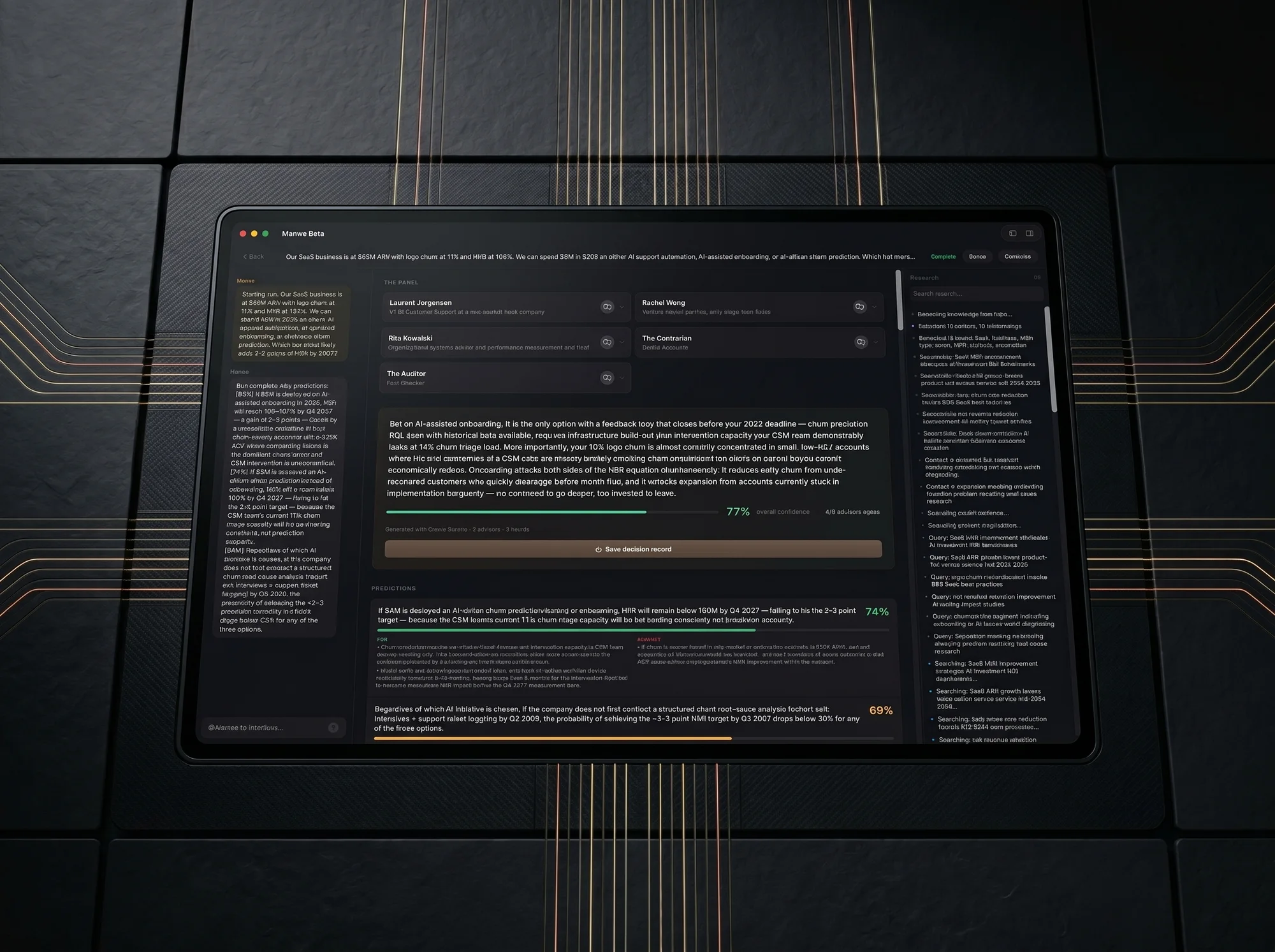
Manwe is not a one-shot chat wrapper. It separates the jobs a serious decision needs: framing, advisor casting, evidence, disagreement, claim checking, futures, memory, and the final record.
The technical surface exists to make the run inspectable: advisors, evidence, forecasts, confidence, and record output stay visible.
System layers
Each layer has a job.
01
Product surfaces
The web app is the fast cloud path for Quick and Pro runs, saved records, seed material, same-language recordings, and Future Paths. The Mac beta adds local-first depth, Worlds, governed memory, scenarios, Lifeline, local models, cloud models, and custom APIs.
02
Decision record layer
Every serious run resolves into an inspectable record: verdict, evidence, dissent, risks, forecasts, Future Paths, Deeper Story, and next actions.
03
Advisor layer
Manwe casts role-bound advisors around the decision type. Specialists sit alongside synthetic pressure roles such as the Contrarian and the Auditor.
04
Evidence layer
Research sources are queried and ranked before and during a run. Seed material can override generic web research when the user provides private context.
05
Claim-check layer
Pro runs can detect fragile claims such as percentages, citations, and dollar amounts, then trigger follow-up research before the final record is written.
06
Futures layer
Forecasts, Future Paths, and Causal Layered Analysis help inspect what the decision could open next and what assumptions sit underneath it.
07
Ontology layer
The Mac beta can build world-scoped memory. Suggestions and Drafts stay out until promoted; only promoted Memory for selected worlds can enter the run.
Web and Mac
Same product. Different depth.
Use the web app when speed, account records, and a clean self-serve path matter. Use the Mac beta when the decision depends on local context, governed memory, scenarios, or model control.
Best first step
Web app
Start a cloud run in the browser.
Mac beta
Download when you want local-first depth.
Records
Web app
Saved account records and exports.
Mac beta
Local-first history plus exports.
Seed material
Web app
Saved seed library and run attachments.
Mac beta
Local documents and run context.
Memory
Web app
Records and seed material.
Mac beta
Worlds, Suggestions, Drafts, promoted Memory, and What Manwe sees.
Scenarios
Web app
Fresh Quick or Pro runs.
Mac beta
Sandbox assumptions, ignored memory, forced outcomes, and Lifeline watchpoints.
Models
Web app
Manwe-managed cloud inference.
Mac beta
Local models, cloud model paths, direct API providers, and custom APIs.
Quick and Pro runs
Quick runs are for faster structured decisions. Pro runs go deeper with claim checks, predictions, and Future Paths.
SourceRanker
Manwe ranks long source material and seed documents so advisors receive relevant evidence instead of a raw dump.
Contrarian and Auditor
The Contrarian challenges the premise and the Auditor pressures claims, assumptions, and weak evidence.
Local and cloud models
The Mac beta supports local models, cloud model paths, direct API providers, and custom OpenAI-compatible endpoints.
Worlds and memory
Worlds separate contexts. What Manwe sees lets the user inspect promoted memory before a run.
Exports
Decision records can be exported as PDF, HTML, or Markdown with verdict, evidence, dissent, risks, forecasts, actions, and source split.
Memory trust
Suggestions are not memory.
The Mac beta includes the governed memory lifecycle: Suggestions are candidates from completed world runs; Drafts are saved for review; Memory is promoted context for selected worlds. What Manwe sees is the audit surface for selected context before a run starts.
This is why the public site should say “memory you control” before it says “ontology.” The implementation is technical, but the user promise is simple: nothing enters the room unless it has been promoted into usable context.
Trust boundaries
Decision support needs visible limits.
Private contextUse seed material and local-first workflows when the decision depends on information generic web search cannot see.Source splitRecords separate cited sources from broader research material so evidence is easier to audit later.Model controlThe web app keeps the path managed; the Mac beta exposes local, cloud, and custom provider options.Product limitsManwe supports decisions. It does not replace licensed legal, medical, financial, or professional judgment.
FAQ
Technical questions.
Is Manwe just a chat wrapper?
No. Manwe separates a decision into framing, advisor roles, evidence ranking, claim checks, dissent, forecasts, memory boundaries, and a final decision record.
What does the evidence layer do?
The evidence layer ranks sources and seed material so advisors work from relevant context instead of treating every uploaded or discovered source as equally useful.
How does memory work in the Mac beta?
The Mac beta separates Suggestions, Drafts, and promoted Memory. Suggestions and drafts stay out until promoted; only promoted Memory in selected worlds can shape future runs.
Can Manwe use local models?
The Mac beta supports local models, cloud model paths, direct API providers, and custom OpenAI-compatible endpoints. The web app uses the managed Manwe path.
What can I export?
Decision records can be exported as PDF, HTML, or Markdown with verdict, evidence, dissent, risks, forecasts, actions, and source split.
From self-serve decision records to stronger shared workflows.
Manwe today is a live web app with a separate Mac beta for local-first workflows. The next step is making the product easier to understand, easier to trust, and clearer about where web and Mac each fit.